We’re getting ourselves ready to build some software to help predict whole house fan energy savings. In the meantime, I put together this spreadsheet, which I think is a pretty good approximation for the coastal areas of California.
Potential Whole House Fan Energy Savings per Year for California
Input Energy cost
$0.24
Dollars per KWH
Application
High Speed Watts
Low Speed Watts
Energy Savings * (per Year)
2.5WHF
288
250
$777.89
2.5eWHF
200
43
$826.70
Air Conditioning
2808
na
$0
* Assumptions are that the cooling season is 5 months, the WHF is run 10 hours/day, 40% use is at low speed, an average deltaT at night is 10º , and that all WHF cooling offsets AC use.
We love the validation that utilities give to the whole house fan concept by sponsoring rebates on our products. Thank You.
BUT… P.G.&E. took longer to put our new model 2.5WHF on their “qualifying list” than it took us to design, test, photograph, market, and sell the first year’s production! Wow ! We are just too quick for you utilities
It was the best of times, it was the worst of times. (Don’t worry; that’s the end of the literary pillaging.) I poked my head outside this afternoon at 5 PM, thinking that maybe I should open the windows to warm the place up a little. As I go outside, I noticed that the neighbor’s AC unit was running. The inside temperature in my home was 72º, outside was 88º. So why am trying to warm up and the neighbor cool down?
Several reasons as it turns out. I’m living in an ICF (insulated concrete form) house that has one of our whole house fans installed. Whereas the neighbor’s house is a low mass stick framed house, and certainly has no whole house fan.
Of course whole house fans are great – but what seems to be a great combination is lots of mass to store “coolth” (made up word meaning the opposite of heat). I’ve been able to survive quite well all summer with just a whole house fan for cooling – no AC. That said,during the second week of 105º days, AC would have been nice for about 4 hours per day.
For the last 7 months, we have been including return labels for the packaging foam on most of our whole house fans. The idea was to see if it was practical to ship the engineered foam inserts back to us for re-use. The payoff would be less garbage, and in this case less energy used.
There is a little bit of work required on the customer’s part like packing up the foam and taking it to a UPS drop off. That was our concern. Would anyone bother ?
Not everybody did. Perhaps they recycled locally. Perhaps they want to save the packaging.
At any rate, over the last seven months, we have had a 34% foam return rate, which is actually better than 34%.
Huh? Why ?
See below and take a math lesson at the same time.
————-Math Lesson ———-
Here is the real beauty of re-use. Once the packaging foam is returned, we use it again, and again, and again…
Expressed mathematically, the Effective Re-use Rate = .34 + (.34 x .34) + (.34 x .34 x .34)+ (.34 x .34 x .34 x .34) + .. … until the foam falls apart
This is a geometric series, and the sum of the series can be calculated as = .34/(1-.34)= .51
If you are interested in the math here is the solution: S=x+x2+x3+x4+… Now S*x=x2+x3+x4+… , So subtract the two terms: S-S*x = x, which simplifies to S = x/(1-x)
The bottom line is that instead of a truck load of 2,000 foam inserts being used once, they will be used 2,000×1.51 = 3,020 times!
It actually costs us a little bit more to have customers send the foam back, but we think it’s a worthwhile cause !
The goal of this project was to apply the energy saving concept of a residential whole house fan to an institution. Our local museum Science Works was a great candidate for this “experiment”. Everybody wants to reduce energy use these days and who better to show off some of the newest (and oldest) concepts than a science museum?
The Science Works building is a very robust concrete structure. That fact alone got us excited about putting whole house fans into the museum because we know that concrete has a large capacity for storing “cool”. We also know that summers in Ashland are plenty hot with a large diurnal temperature variation (big words for “it gets cold at night” ). And of course, what better way to cool the museum than with a couple of our whole house fans.
Installing the Fans
The Install
Since the fans would only run at night, and nobody spends the night here, we modified our 4.5WHF units to push a little more air. Basically we removed the noise attenuating ductwork. The plan was to use a pair of the fans, which will exhaust 10,000 CFM (cubic feet per minute) from the building. By using our 4.5WHF units , we made it easy for the contractor to provide well insulated (R-10) and sealed damper doors. A typical commercial project would involve ordering custom dampers and fans and probably many decision makers.
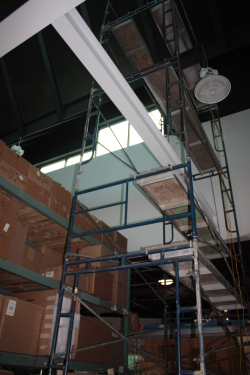
A clerestory window over a warehouse area of the museum was selected as the logical location because of its height (remove all that hotter air) and relative ease in waterproofing (no roofing work!). A scaffold was built and a local contractor (all organized by Science Works director Mark Dirienzo) installed the units.
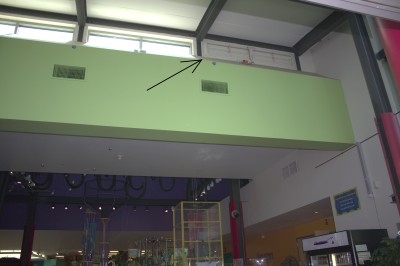
So, we solved the problem of getting the air out, but what about letting fresh air in. It’s not practical to leave windows open all night, but whoever designed the museum must have been thinking ahead. We found 2 sets of dampers high up above the entry way.
Dampers Above Entryway
Better yet, motorized actuators were found to be in working order. The plan is to setup an automatic timer that opens up the dampers and turns on the fans every night at 10:00 PM. The weather is predictable enough here that we don’t need anything more complicated.
Operation
Last night, we opened up the intake dampers and turned on the fans. No hard numbers yet, but we got the main entryway down to 67°, which is way better than the usual 78°. We’ll report back on the results as we gather data on temperatures and energy use.
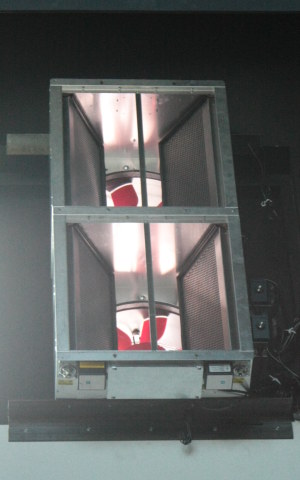
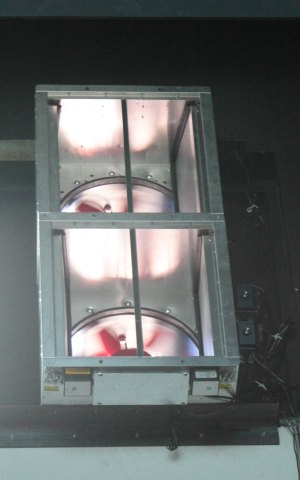
WHF Doors OpeningWHF Fans Running
Technical Data
10,000 CFM with outside air 10° cooler than inside
This yields about 9 tons of cooling.
We expect to be able to run the fans for 10 hours per night based on historical weather data.
We estimate a savings of 20% of the museum’s cooling energy.
Low leakage windows, better insulation, and more efficient heating and cooling systems are among the many wonderful energy saving products and techniques that allow us to build very efficient houses.
Houses built to the high standards of a passivhaus , can use as little as 10% of the energy required to run the average U.S. single family house. For so many reasons, reducing energy use is critical to our society’s future. So….. let’s build a bunch of new passiv houses with an American flair. Well…..here’s the problem.
In a typical year, the housing industry produces about 1.5 million new housing units per year. This is within a base of approximately 128,000,000 existing housing units. (source census.gov). So, it would take about 85 years (with no population growth) to replace all of our existing houses.
This leads us to the conclusion that we must devise a way to make our existing housing stock efficient users of energy. It’s not a simple task. Standards must be developed and a process must be implemented. Oh, and by the way, perhaps government (good government) should direct this. I think we’re not even going to ask the finance industry to be involved in this one 🙂

 About
About